

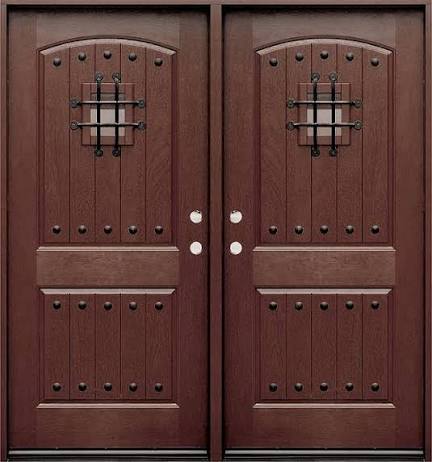
Application guide
Resin for FRP Door Manufacturing
FRP doors need a laminate that bonds well to the door-skin substrate and holds its shape and strength through years of daily use.
Dimensionally stable, long service life.
What manufacturers build
Why this material suits the work
Required resin characteristics
- Strong adhesion to door-skin substrates and core materials
- Cured dimensional stability so the door doesn't warp or bind in its frame over time
- Good mechanical strength to handle repeated opening, closing and impact
- A workable gel time for laminating reinforcement into frame and edge sections
- Consistent cure quality across every door in a production batch
Process context
Advantages
- Reliable adhesion keeps the door-skin-to-core bond intact through years of daily use
- Non-accelerated cure system gives fabricators control over working time during assembly and clamping
- One documented grade across a door production run keeps the laminate consistent from batch to batch
- Consistent 99% purity supports uniform bonding quality across every door in a batch
Common products
- FRP bathroom and utility doors
- Exterior-rated FRP door shutters
- FRP door frames
- Moulded panel-design door skins bonded to core structures
Common questions
GP Clear Resin works well for general FRP door fabrication and frame reinforcement. If your production is high-volume and focused specifically on door-skin lamination, Samrat FRP Traders' Lamination Resin (LR Resin) is tuned more precisely for that bonding process.
Door frames and edge sections are typically reinforced with E-glass chopped strand mat, wet out with catalysed resin during lamination.
Once fully cured, GP Clear Resin forms a dimensionally stable laminate that helps the door hold its shape through humidity and temperature changes — proper cure time and correct catalyst dosage are both important to achieving this.
It is cured at room temperature with an MEKP catalyst (around 1.5%) and a cobalt octoate accelerator (around 0.4%), adjusted to give enough working time for clamping and assembly before the laminate gels.
It is suitable as a general-purpose laminating resin for both. Overall door performance also depends on the core material, door-skin quality and any protective coating applied, not the resin alone.
Need resin for your FRP door production?
Get a bulk quote or talk to our technical team about the right grade and dosage for your door fabrication line.
Contact Samrat FRP Traders