Industrial & Specialty Resins
Pultrusion Grade Resin
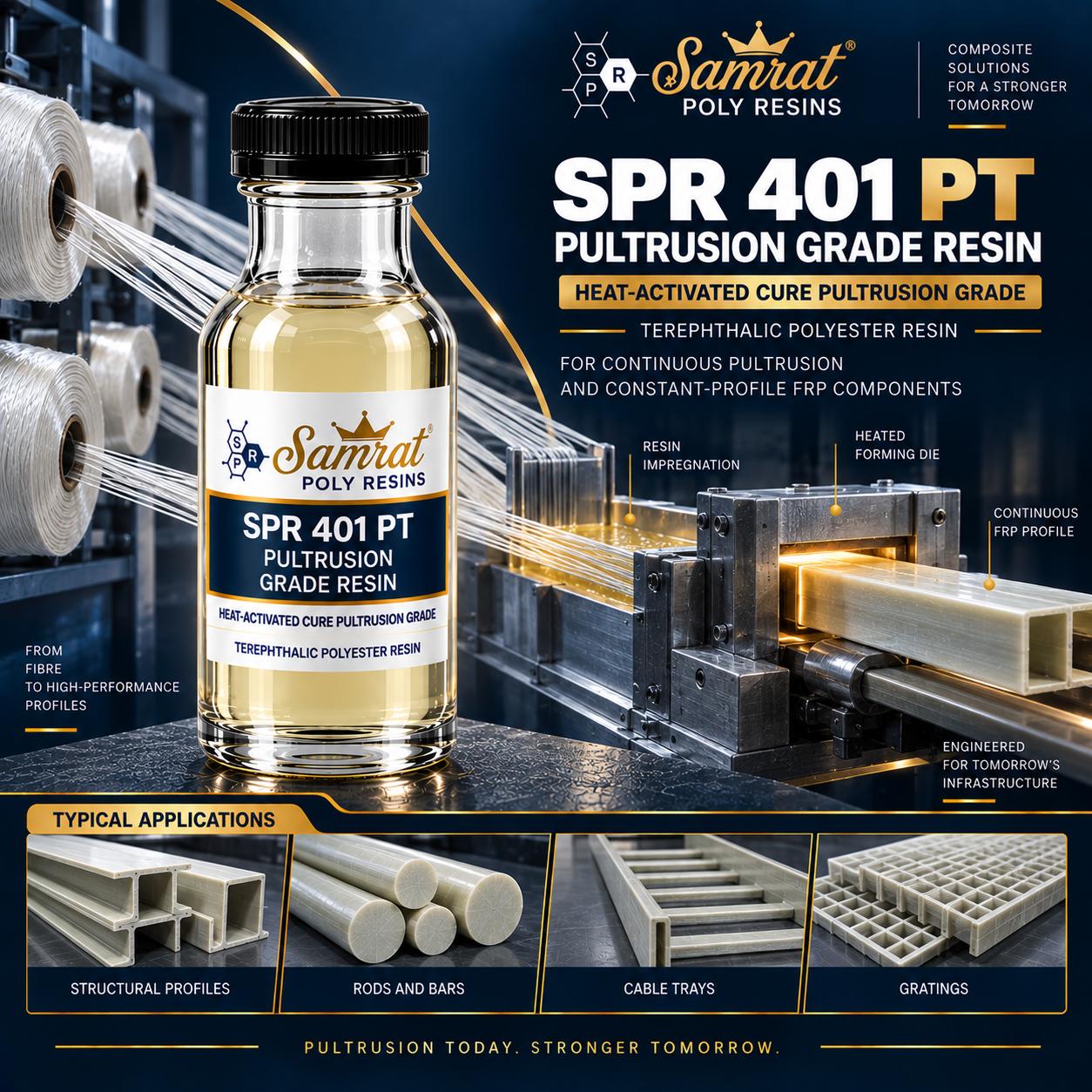
A Samrat Poly Resins, India grade, SPR 401 PT. Enquire with Samrat FRP Traders for supply, pricing and packaging in Nepal.
Price
PRICE ON REQUEST
Pultrusion Grade Resin pricing varies based on:
- Order Quantity
- Product / Resin Grade
- Current Raw Material Rates
Technical documents
Download Technical Data SheetPDFFull product rangeProduct catalogue · PDF, 16 pagesBrowse the document libraryDocuments issued by: Samrat Poly Resins, India
High-strength terephthalic grade with strong mechanical properties for continuous pultrusion, run on a heat-activated peroxide system.
Catalogue codeSPR 401 PT
Terephthalic polyester resin for continuous pultrusion
Resin chemistryTerephthalic Polyester Resins (SPR 401)
- Manufacturer
- Samrat Poly Resins, Doraha, India
- Nepal supplier and importer
- Samrat FRP Traders
- Technical information issued by
- Samrat Poly Resins (2026 catalogue)
- Price, packaging, lead time in Nepal
- Confirmed on enquiry
About this product
SPR 401 PT is the terephthalic pultrusion grade. The supplier describes a high-strength resin with excellent mechanical properties for continuous pultrusion, and lists pultruded FRP profiles and structural sections.
Production pultrusion uses a heat-activated peroxide blend at a total dosage of 1.0–2.0%, with 0% MEKP and 0% cobalt. The hot-die gel time is 40–80 seconds at 130–140 °C; the ambient gel time of 15–25 minutes at 25 °C is a quality-control figure only.
Samrat FRP Traders handles enquiries for this Samrat Poly Resins, India grade in Nepal. Pricing, packaging and availability are confirmed on enquiry.
What this means for buyers
Not an ambient-cure resin
Do not run this grade on the MEKP and cobalt system used for hand lay-up. Pultrusion cures it in the heated die.
Die conditions matter
Die temperature, pull speed and the peroxide blend decide the cure. Share your line set-up when you enquire.
Key features
- High-strength terephthalic polyester resin
- For continuous pultrusion
- Heat-activated peroxide production cure
Typical specification
- Appearance
- Clear, light-straw to amber liquid
- Viscosity
- 300–600 cPs at 25 °C
- Hot-die gel time
- 40–80 seconds at 130–140 °C
- Ambient QC gel time
- 15–25 minutes at 25 °C
- Specific gravity
- 1.10–1.14
- Styrene content
- 36–42% by weight
- Supply condition
- Non-accelerated · non-thixotropic
- Production cure
- Heat-activated peroxide blend, total dosage 1.0–2.0% — added separately during processing
- Production MEKP
- 0%
- Production cobalt
- 0%
Source: Samrat Poly Resins, India — product catalogue, 2026 edition (typical specification)
How to read these values
- Production pultrusion runs on a heat-activated peroxide blend (1.0–2.0% total dosage), with 0% MEKP and 0% cobalt. The ambient gel time is a quality-control figure, not a production cure.
- These are typical values from the supplier’s product catalogue. They describe the grade; they are not batch guarantees or acceptance limits.
- Resin data does not guarantee the performance of a finished FRP component. Confirm suitability with a trial on your own process, reinforcement and cure conditions.
Applications and processes
Uses listed in the supplier’s catalogue.
- Continuous pultrusion processing
- Pultruded FRP profiles and structural sections
Limitations
- The ambient gel time is a QC test, not the production cure. A profile’s structural capacity comes from its fibre, die, line speed and cure, not from resin data.
- The values shown are typical catalogue values for the grade, not batch guarantees, acceptance limits or a Technical Data Sheet. Confirm the current data before relying on a figure.
- Resin data does not describe a finished part. Strength, durability, fire behaviour and chemical resistance of a part depend on its design, reinforcement, process, cure and testing.
When to consider a different resin
These grades are made for a different situation. Match them against your own service conditions.
- Filament Winding Grade Resin (SPR 301 FW)Filament-wound FRP pipes and tanks.
- Vinyl Ester ResinThe chemical service is more aggressive than a polyester lining is specified for.
Comparison table
| Criterion | Pultrusion Grade Resin (SPR 401 PT) | Filament Winding Grade Resin (SPR 301 FW) | Vinyl Ester Resin |
|---|---|---|---|
| Chemistry | Terephthalic unsaturated polyester | Isophthalic unsaturated polyester | Bisphenol-A epoxy vinyl ester |
| Supply condition | Non-accelerated · non-thixotropic | Non-accelerated · non-thixotropic | Not listed in the TDS summary |
| Viscosity | 300–600 cPs at 25 °C | 200–400 cPs at 25 °C | 350 cPs at 25 °C |
| Gel time | 40–80 seconds at 130–140 °C (hot-die gel time) | 20–60+ minutes at 25 °C | 15–20 minutes at 25 °C |
| Cure system | Heat-activated peroxide blend, total dosage 1.0–2.0% — added separately during processing (production cure) | MEKP 1.5% + Cobalt Octoate approximately 0.4% — added separately during use | Not listed in the TDS summary |
| Listed uses | Continuous pultrusion processing; Pultruded FRP profiles and structural sections | Filament-winding processes; Filament-wound FRP pipes and tanks | Chemical-service linings and structures; marine composites |
| Choose when | Continuous pultrusion of profiles on a heat-activated cure. | Filament-wound FRP pipes and tanks. | The chemical service is more aggressive than a polyester lining is specified for. |
Sources: the 2026 product catalogue of Samrat Poly Resins, India for the catalogue grades, and each earlier product’s published Technical Data Sheet summary. Values are typical and were measured under the conditions each source states, so they are a guide to selection, not batch guarantees. Viscosities measured at different spindle speeds or shear conditions are not directly comparable.
Manufacturing and quality context
Samrat Poly Resins manufactures the grade in Doraha, Punjab, India. Its 2026 catalogue presents every grade under its resin chemistry and code and describes a quality inspection laboratory at Doraha. Batch-specific questions, gel-time or viscosity queries and clarification of catalogue values are answered by the manufacturer’s technical team.
The catalogue recommends a trial on the customer’s own process and reinforcement before commercial use: typical values are not a substitute for a trial. Technical and safety data sheets are issued grade by grade: this grade’s Technical Data Sheet is published on this page, and a Safety Data Sheet has not been issued for it here. Ask for the current revision before relying on a document.
Samrat FRP Traders supplies and imports the grade for Nepal and handles enquiries. It does not manufacture, reformulate or certify resins.
Related process guides
These guides are written for another grade. They explain the process; they do not approve this grade for it.
Handling and safety
- Use suitable personal protective equipment and adequate ventilation.
- Store resin, initiators and accelerators separately, in original sealed containers, cool, shaded and away from heat and ignition sources.
- Add the initiator and the accelerator to the resin separately, according to the confirmed process.
- Never mix a concentrated peroxide initiator directly with a cobalt accelerator.
Product details
Applications
Product comparisons
Frequently asked questions
Can I cure it with MEKP and cobalt?
Not for production pultrusion. The catalogue specifies a heat-activated peroxide blend with 0% MEKP and 0% cobalt.
What is the ambient gel time for?
Quality control. It is measured at 25 °C and is not the production cure.
Is a technical or safety data sheet available?
Yes. The supplier’s Technical Data Sheet for this grade is published on this page — Doc. Ref SPR-TDS-PTR, Rev. 01, September 2026, issued by Samrat Poly Resins, India. No Safety Data Sheet has been issued for this grade on this site; ask us and we will request the current one.
Is cobalt used in production?
No. Production cobalt is 0% and production MEKP is 0%; the line runs on a heat-activated peroxide blend of 1.0–2.0% in total.
What is the hot-die gel time?
40–80 seconds at 130–140 °C, according to the catalogue.
Knowledge hub
A fuller explanation of this grade’s chemistry, values and limits.
Related products