

Application guide
Resin for Spray-Up Process
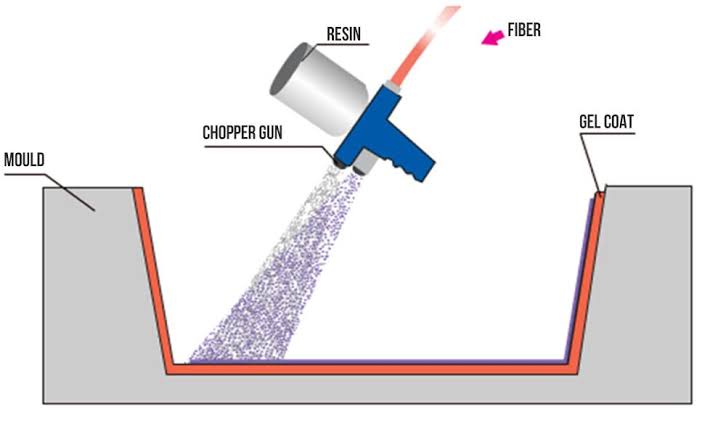
Spray-up production needs a resin that atomises cleanly through spray equipment and gels on a predictable schedule.
Full control over gel timing at scale.
What manufacturers build
Why this material suits the work
Required resin characteristics
- A viscosity compatible with chopper-gun atomisation without clogging equipment
- Predictable gel timing that can be tuned to the spray rate and size of the mould
- Even resin distribution alongside chopped roving as it's deposited on the mould
- Reliable mechanical strength once the sprayed laminate is compacted and cured
- Consistent behaviour across repeated spray cycles in a production run
Process context
Advantages
- Compatible viscosity for clean atomisation through standard spray-up equipment
- Non-accelerated cure system lets fabricators dial in gel time to match spray rate and mould size
- Sub-8-minute gel time supports faster cycle times than hand lay-up on larger parts
- Consistent 99% purity maintains laminate quality across high-volume spray production
Common products
- Water tanks and sanitaryware produced at volume
- Bathtubs and moulded bathroom fixtures
- Cooling tower panels and casings
- General FRP panels with large surface areas
Common questions
Yes, its viscosity is compatible with standard spray-up equipment. As with any resin, operators should check compatibility with their specific spray equipment setup and adjust accelerator dosage to suit.
Because spray-up deposits resin and reinforcement faster than hand lay-up, gel time is tuned to the operator's spray rate and the mould's size — enough time to complete all passes and roll out air, but not so long that production slows unnecessarily.
Spray-up uses continuous glass roving fed through the chopper gun and cut on application, rather than pre-cut chopped strand mat — but the resin's role in wetting out that reinforcement is the same.
It is cured at room temperature with an MEKP catalyst (around 1.5%) and a cobalt octoate accelerator (around 0.4%), with dosage adjusted to the operator's spray rate and the equipment being used.
Spray-up generally suits higher-volume production of moderately complex shapes where labour savings matter most; hand lay-up gives more control for complex geometries or lower-volume work. Both use the same GP Clear Resin.
Need resin for your spray-up production?
Get a bulk quote or talk to our technical team about the right grade and dosage for your spray-up process.
Contact Samrat FRP Traders