
Application guide
Resin for FRP Cooling Tower Manufacturing
Which resin grade suits which cooling tower component — casings, fan stacks, louvres and basins — and how water treatment, temperature and lay-up method decide the choice.
One guide for every cooling tower grade in the range, with the questions that settle the choice.
A cooling tower is one of the wettest jobs in an industrial plant. Warm water is pumped over the fill, air is dragged through it, and the structure around that process never really dries out. Steel corrodes in it and timber decays in it, which is why the casing, fan stack, louvres and basin of most modern towers are laminated from glass-reinforced polyester instead.
The resin is what turns glass reinforcement into that structure, and the range carries more than one grade for it: the general-purpose grades GP Clear Resin and GP Yellow Resin, the two thixotropic cooling-tower grades from the 2026 catalogue — Orthophthalic Cooling Tower Grade Resin (SPR 201 CTG) and Isophthalic Cooling Tower Grade Resin (SPR 301 CT) — and, where the water chemistry is harsher than a polyester laminate is specified for, Vinyl Ester Resin. This guide sets out which grade fits which component and which question decides it.
What manufacturers build
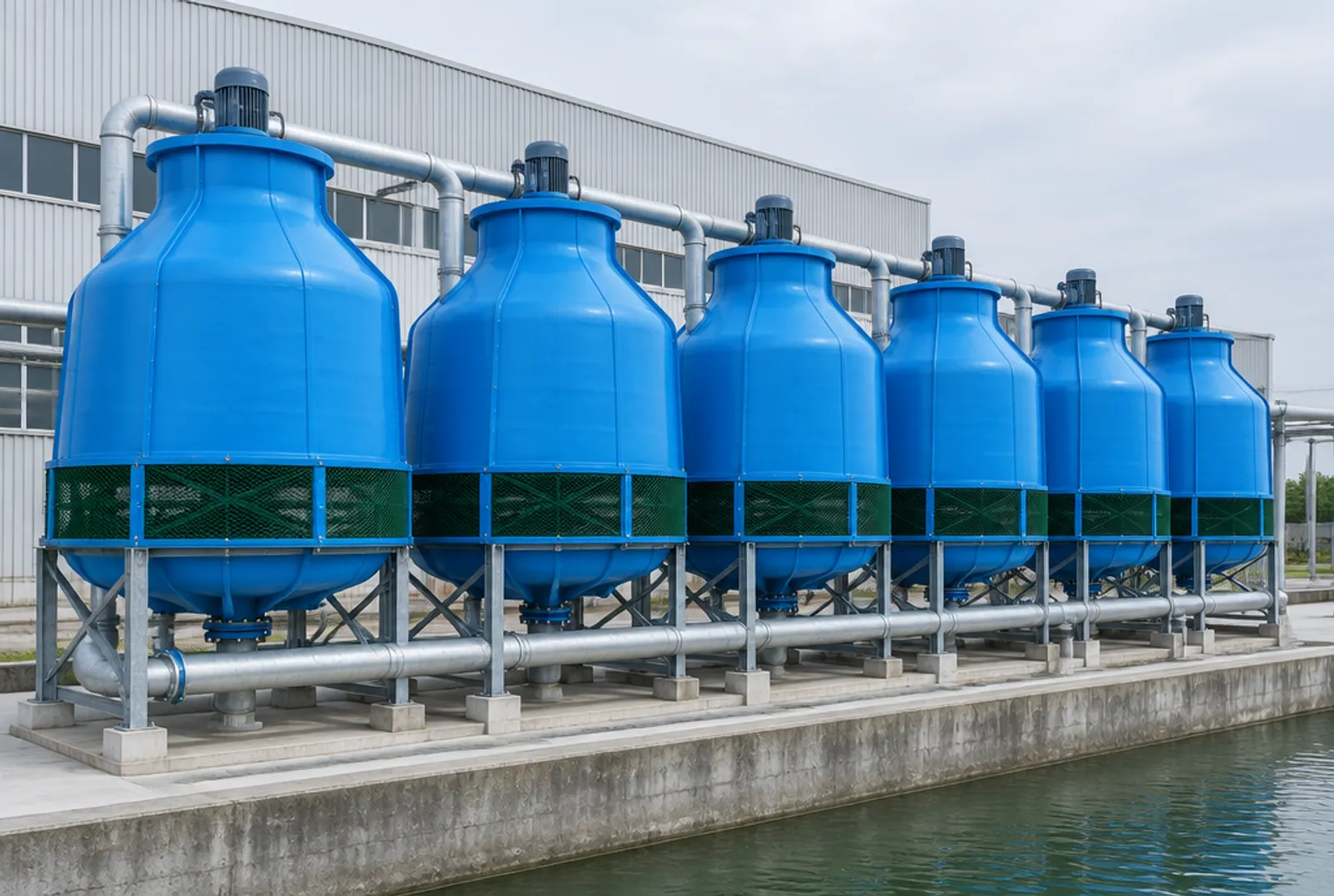
Cooling tower fabricators in Nepal work on two kinds of tower. Package (bottle) towers arrive as moulded FRP shells — the round blue units seen beside plant rooms, hotels and hospitals — and field-erected induced-draft towers are assembled on site from panels and structural sections.
The FRP scope usually covers the casing and shell panels, the fan stack or fan cylinder, air-inlet louvres, the cold-water basin or basin lining, internal partitions and baffle walls, fan blades and motor supports where the design calls for them, and access items such as ladders, handrails and walkway gratings. Not every part of a tower is FRP: the fill pack and drift eliminators are normally moulded thermoplastic (usually PVC or PP) supplied as a separate item, and the motor, gearbox and pipework are bought in.
Why this material suits the work
Every grade below cures at room temperature with the same two-part workshop system — MEKP hardener with a cobalt octoate accelerator, each added to the resin separately — so a fabricator can move between them without re-equipping. What separates them is body, gel time and chemistry.
GP Clear Resin is the general-purpose starting point: 350–450 cPs, a gel time under 8 minutes and 33–40% styrene, which wets chopped strand mat out quickly on flat and gently curved panels. GP Yellow Resin is the same orthophthalic chemistry in a thicker, slower grade — 450–600 cPs and a 10–15 minute gel time — which buys working time when several large panels are laminated in one shift. GP White Resin is the white-pigmented grade on that same GP base specification, and the supplier lists cooling towers among its uses: worth considering where a white laminate is wanted without a separate pigment addition.
The two catalogue cooling-tower grades are thixotropic: formulated to thicken at rest and thin again under a brush or roller, so the resin stays where it is put on a vertical shell instead of draining to the bottom of the panel. Orthophthalic Cooling Tower Grade Resin (SPR 201 CTG) is the orthophthalic one, listed at 350–450 cPs with a gel time under 8 minutes. Isophthalic Cooling Tower Grade Resin (SPR 301 CT) is the isophthalic one, and the catalogue publishes its rheology in full: 400–650 cPs at 60 rpm against 1,500–2,000 cPs at 6–12 rpm, a thixotropic index of 2.0–3.5, a gel time of 15–35 minutes and 37–45% styrene, with heat, chemical and corrosion resistance and high strength listed against it.
Required resin characteristics
- Even wet-out of chopped strand mat over large panel areas, with no dry patches at ribs, corners and bolt lines
- A gel time matched to the panel size and the shift: short for quick turnover of small parts, longer for a big shell laid up in one pass
- Sag resistance where the lay-up is vertical or steeply curved — the property the two thixotropic grades are formulated for
- A laminate that holds up under permanent wetting and the plant’s own water treatment, which means naming the treatment before the grade is fixed
- Batch-to-batch consistency, so panel thickness and cure do not drift across the hundreds of square metres a single tower needs
- Room-temperature cure that still works at the ambient temperature of the workshop, which in Nepal swings widely between a Terai summer and a winter morning in the hills
Cooling tower grades compared
| Criterion | GP Clear Resin | GP Yellow Resin | SPR 201 CTG | SPR 301 CT | Vinyl Ester Resin |
|---|---|---|---|---|---|
| Chemistry | Orthophthalic polyester | Orthophthalic polyester | Orthophthalic polyester | Isophthalic polyester | Bisphenol-A epoxy vinyl ester |
| Rheology | Not classified as thixotropic | Not classified as thixotropic | Thixotropic; index not published | Thixotropic; index 2.0–3.5 | Not classified in the TDS summary |
| Viscosity | 350–450 cPs | 450–600 cPs at 25 °C | 350–450 cPs | 400–650 cPs at 60 rpm; 1,500–2,000 cPs at 6–12 rpm | 350 cPs at 25 °C |
| Gel time | Under 8 minutes | 10–15 minutes | Under 8 minutes | 15–35 minutes at 25 °C | 15–20 minutes at 25 °C |
| Cure system | Non-accelerated; MEKP + cobalt octoate at the workshop | Non-accelerated; MEKP + cobalt octoate at the workshop | Non-accelerated; MEKP 1.5% + cobalt octoate 0.4%, added separately | Non-accelerated; MEKP 1.5% + cobalt octoate 0.4%, added separately | Not stated in the TDS summary |
| Listed for | General FRP: tanks, panels, sheets, moulded parts | General FRP work in the supplier’s TDS | Cooling-tower and wind-turbine FRP components; sag-resistant lay-up on vertical surfaces | Cooling-tower and wind-energy composite components | Chemical-service linings and structures; marine composites |
| Choose when | Flat or gently curved panels, fast turnover, ordinary treated water | Large panels need more working time than GP Clear allows | The lay-up is vertical and the service is ordinary | The lay-up is vertical and heat, chemical or corrosion resistance is wanted | The water chemistry is harsher than a polyester laminate is specified for |
Sources: the supplier Technical Data Sheet summaries published on each product page, and the 2026 product catalogue of Samrat Poly Resins, India for SPR 201 CTG and SPR 301 CT. Values are typical for the grade, not batch guarantees, and viscosities measured at different spindle speeds do not compare directly. No service-temperature limit or chemical-resistance list is published for these grades on this site.
The environment the laminate actually lives in
Four things act on a cooling tower laminate at once, and each one points at a different part of the decision.
- Permanent wetting. Internal surfaces are wet whenever the tower runs, and damp even when it does not. This is the reason isophthalic chemistry is offered for the job at all: Isophthalic Cooling Tower Grade Resin (SPR 301 CT) and ISO Polyester Resin are the isophthalic grades in the range.
- Warm water. The circulating water leaves the process warm. No service-temperature limit is published for these grades on this site, so where a plant runs hotter than ordinary comfort-cooling duty, ask for the operating temperature to be checked against the grade before ordering.
- Water treatment. Biocides, chlorine, scale and corrosion inhibitors are dosed into the circuit. The chemical, its concentration and the temperature decide whether a polyester laminate is appropriate or whether Vinyl Ester Resin is the right route. Neither this page nor the product pages publish a chemical-resistance chart.
- Sun and weather. The outside of a tower sits in full sun. A pigmented gelcoat is what takes that exposure, not the structural laminate underneath.
Surface finish and gelcoat
The mould-face surface of a tower shell is usually a gelcoat, laid into the mould before the structural laminate. GP Gelcoat Resin is the general white, high-gloss, thixotropic gelcoat in the range. ISO Gelcoat is the isophthalic one; its TDS summary publishes a pre-accelerated system, 40,000 cPs at low shear against 1,500 cPs at high shear, a thixotropic index of 26, an 8-minute gel time and a 700 µm target wet film within a 600–800 µm range, and the 2026 catalogue positions the isophthalic gelcoat where the surface faces weathering or water contact.
Note the difference in cure: the ISO Gelcoat is supplied pre-accelerated, so only MEKP hardener is added at the bench, while the laminating grades above are non-accelerated and take both catalyst and accelerator. Colour, film thickness and the finish a customer will accept are worth settling in writing before the first shell is pulled.
Process context
Casing panels, shells and basin sections are laminated by hand lay-up, and larger shops chop and spray with a spray-up gun. chopped strand mat is laid into the mould and wetted out with resin catalysed by MEKP hardener and accelerated with cobalt octoate; the two are added to the resin separately and never mixed with each other first. Layers are built up to the thickness the design calls for, with extra plies at ribs, edges, bolt lines and lifting points.
Where the mould face is vertical or steeply curved — a package tower shell, a fan cylinder — a thixotropic grade holds the wet laminate in place while it gels. Panels cure at room temperature, then are trimmed, drilled and assembled with the tower’s steelwork or bolted shell-to-shell. Confirm the catalyst and accelerator dosage for the shop temperature on the day, and run a trial laminate before committing a production run to a grade that is new to the shop.
Advantages
- One cure system across the range — MEKP with a cobalt octoate accelerator — so a shop can change grade without changing its process
- A thixotropic option for vertical shells and fan stacks, where an ordinary laminating resin drains before it gels
- An isophthalic option where the part faces heat, treated water or corrosion, without leaving the polyester family
- A documented upgrade path to vinyl ester when the water chemistry is beyond what a polyester laminate is specified for
- Reinforcement, catalyst and accelerator supplied alongside the resin for Nepal, so a tower line is sourced from one place
Common products
- FRP casing and shell panels for package and field-erected towers
- Fan stacks, fan cylinders and motor supports
- Air-inlet louvres and internal partition or baffle walls
- Cold-water basins and basin linings
- Ladders, handrails and walkway gratings around the tower
Questions to settle before you fix a grade
- Which component is being laminated — an external casing panel, an internal partition, a fan stack or the basin?
- Is the lay-up flat, or vertical and steeply curved enough to need a thixotropic grade?
- What treatment is dosed into the circulating water, at what concentration, and how hot does the water return?
- How big is a single lay-up, and how long must the resin stay workable to finish it in one pass?
- What is the workshop temperature during the production run, and has the catalyst and accelerator dosage been set for it?
- Does the end customer’s specification name a resin type, a gelcoat colour or a laminate thickness?
- Is there a fire requirement for the plant room or enclosure the tower sits in?
- What quantity is needed, and by when, so supply into Nepal can be planned?
When to consider another resin
- Harsh water chemistry. Where the dosing is aggressive or the water is hot, Vinyl Ester Resin is the chemical-service route; the decision belongs to the named chemical, its concentration and the temperature, not to the resin’s name.
- General wet or chemical service without a vertical lay-up. ISO Polyester Resin is the plain isophthalic laminating grade — 500 cPs, a 15-minute gel time, 40% styrene and a 90 °C heat deflection temperature in its TDS summary, which is resin data rather than a service limit.
- A fire requirement. If the enclosure or plant room specifies fire-retardant laminates, that requirement belongs to the fire-retardant grades, and it is decided by the finished, tested part rather than by the resin alone.
- Structural sections rather than mouldings. Walkway and support sections pulled as continuous profiles are a pultrusion job — see Pultrusion Grade Resin (SPR 401 PT) and the pultrusion guide.
- Translucent roof panels over the tower. That is sheet work, covered by the roof-light sheet guide, not by a cooling-tower grade.
Common questions
For flat or gently curved panels in ordinary treated water, GP Clear Resin is the general-purpose starting point and GP Yellow Resin is the same chemistry with more working time. Where the panel is laminated vertically, the thixotropic SPR 201 CTG or SPR 301 CT is the grade formulated to stay in place. The water treatment and the plant’s own specification decide between the orthophthalic and isophthalic routes.
Both are orthophthalic unsaturated polyester resins cured at room temperature with MEKP and cobalt octoate. GP Clear Resin is listed at 350–450 cPs with a gel time under 8 minutes; GP Yellow Resin at 450–600 cPs with a 10–15 minute gel time. The thicker, slower grade buys working time on a big panel at the cost of a longer cycle.
When the resin has to stay on a vertical or steeply curved mould face — a package tower shell, a fan cylinder, an internal wall — long enough to gel. A thixotropic grade thickens at rest and thins under the brush or roller. On flat moulds the property is not needed.
No. Fill and drift eliminators are normally moulded thermoplastic — usually PVC or PP — bought in as a separate item. The resins on this page are for the laminated FRP parts: casing and shell, fan stack, louvres, partitions, basin and access items.
No. Service life comes from the whole build — laminate thickness and reinforcement, cure, gelcoat, joint detailing, the water treatment the plant runs and the maintenance it gets. Resin data describes the resin, and this site publishes no life expectancy, warranty or service-temperature limit for a finished tower.
When the circulating water is dosed harder than a polyester laminate is specified for, or runs hotter than the polyester grades are intended for. Name the chemical, its concentration and the temperature when you enquire — neither this page nor the product pages publish a compatibility chart, so the answer comes from that information rather than from the resin name.
Samrat Poly Resins, India manufactures them and issues their technical documents. Samrat FRP Traders is the Nepal supplier and importer: it handles enquiries, quotations and local technical assistance, and confirms price, packaging, lead time and stock on enquiry.
Related guides
- GP Yellow Resin for cooling towersThe GP Yellow route in detail: thicker body, longer gel time, same cure chemistry.
- What is SPR 201 CTG?The orthophthalic cooling-tower grade, its catalogue values and its limits.
- What is SPR 301 CT?The isophthalic grade, its two viscosities and its thixotropic index.
- SPR 201 CTG vs SPR 301 CTA decision table for the two thixotropic grades, side by side.
- FRP effluent and process tanksWhere an isophthalic laminate sits when water is the service, not the coolant.
- How to select a polyester resinThe general selection method behind the choices on this page.
Manufacturer and Nepal supplier
Samrat Poly Resins, India manufactures the grade and issues its technical information. Samrat FRP Traders is the Nepal supplier and importer and handles enquiries; price, packaging, lead time and stock in Nepal are confirmed on enquiry.
Building cooling towers in Nepal?
Tell us the component, the lay-up method, the water treatment and the quantity, and Samrat FRP Traders will confirm the grade, price, packaging and lead time for Nepal.
Contact Samrat FRP Traders